RECENT
→
About Skills Education Projects Research Labs Field Notes Cyberspace Contact
Jishnu EC
JISHNU EC
Offensive & Defensive Security Specialist
Penetration Tester  ·  SOC Analyst  ·  OSINT Researcher
jishnu@kali:~$ bash
❯ whoami
jishnu_ec — cybersecurity analyst
 
❯ cat skills.conf
pentesting = enabled
siem_analysis = enabled
osint = enabled
forensics = enabled
network_sec = enabled
 
❯ cat profile.conf
location = Kozhikode, Kerala
degree = BCA, Calicut Univ 2025
cert = CSA (EC-Council)
status = OPEN_TO_WORK ●
 
❯ tip
press / to search notes & research
 
// this terminal is live — click below and type 'help'
❯
OPEN TO WORK — HIRE ME SOC Analyst · Cybersecurity Analyst · Pentest
SCROLL
0
Field Notes Logged
0
Certifications Earned
0
Projects Shipped
0
Platforms Active
01About Me

I'm a cybersecurity enthusiast with a strong foundation in both offensive and defensive security. From understanding how attacks are carried out to building defenses that stop them — I'm passionate about both sides of the field.

My focus areas include penetration testing, privilege escalation, SOC operations, SIEM & log analysis, OSINT, network security, and digital forensics. I believe the best defenders think like attackers — so I invest heavily in understanding real-world attack techniques, not just theory.

I'm ready to contribute as a SOC Analyst or Penetration Tester — bringing a sharp eye for threats, a hands-on technical mindset, and the drive to protect what matters.

OPEN TO WORK
SOC Analyst  ·  Pentest  ·  Cybersecurity Analyst
SOC Analyst  · Penetration Tester  · Cybersecurity Analyst  · Threat Hunter  · SOC Analyst  · Penetration Tester  · Cybersecurity Analyst  · Threat Hunter  · 
👤 Name
Jishnu EC
📍 Location
Kozhikode, Kerala
🎓 Degree
BCA — 2025
🛡️ Cert
CSA
02Skills & Arsenal
● OFFENSIVE
Attack & Penetration
NmapMetasploitBurp Suite HydraNetcatJohn the Ripper NiktoGobusterSQLMap Aircrack-ngDirb
● DEFENSIVE
Detection & Monitoring
SplunkWiresharkOPNsense SIEM & Log AnalysisIncident Response Threat IntelligenceVulnerability Assessment OWASP Top 10TCP/IP & Networking Active DirectoryDigital Forensics VolatilityOSINTCTF Competitions Penetration Testing
// Languages & Scripting
PythonBashHTML / CSSSQL
// Operating Systems
Kali LinuxParrot OSArch LinuxLinux MintUbuntu / DebianWindows Server
// Virtualization & Infra
VirtualBoxDockerOPNsense FirewallVM NetworkingNAT / Bridge ConfigVLAN Setup
// Dev & Workflow
Git & GitHubVS CodeLinux TerminalMarkdown
03Education & Certifications
🎓
Completed
// Core Credential — Priority 01
Bachelor of Computer Applications
Calicut University, Kerala
Duration2022 — 2025

Undergraduate degree covering programming fundamentals, networking, databases, and systems — the foundation everything since has been built on.

Computer ScienceProgrammingNetworking
Foundational degree — no single-file certificate to view
EC-Council CSA Badge
Earned
// Core Credential — Priority 02
Certified SOC Analyst (CSA)
EC-Council
IssuedJun 29, 2026

Validates practical Tier I & II SOC skills — log management, SIEM operations, incident detection, and threat intelligence in real security operations.

SOC OperationsSIEMThreat Detection
View Certificate
🖥️
Earned
// Priority 03
CICSA V3 — Certified IT Infrastructure & Cyber SOC Analyst
RedTeam Hacker Academy
IssuedJun 30, 2026

Covers IT infrastructure fundamentals alongside SOC analyst skills — system administration, network defense, and cyber operations monitoring.

IT InfrastructureSOC AnalystCyber Operations
View Certificate
🔒
In Progress
// Priority 04
Certified in Cybersecurity (CC)
ISC2
StatusIn Progress

Entry-level credential covering the core domains of cybersecurity — security principles, incident response, access control, network security, and security operations.

Security PrinciplesIncident ResponseNetwork Security
In progress — certificate will be added once earned
04Projects
OSINT Tool
InstaGrep
v4.0 — ~3,000 Lines of Code

Professional Instagram OSINT desktop application. Extract public profile data, analyze posting patterns, download media, generate reports. Features dark UI, keyboard navigation, recent searches, activity charts, and multi-format exports.

PythonCustomTkinterInstagrapiMatplotlibPillowOSINT
Recon Framework
ReconFrame
Advanced Reconnaissance Framework — 12 Integrated Tools

Professional-grade reconnaissance framework that unifies 12 security tools with intelligent automation. Features cinematic startup animation, smart IP/domain detection, and beautifully formatted results.

PythonNmapBashANSITerminal UI
Terminal Application
TerminalChat
Anonymous Real-Time Terminal Chatrooms

Anonymous real-time chat rooms from the command line — no account, no signup. Create or join rooms with just a number. Password-protected rooms, admin controls, emoji reactions, typing indicators, DMs. Cross-platform.

GoBubble TeaLipglossAbly SSERenderTerminal UI
🚩 CTF Machine
Udyama (उद्यम)
Linux Privilege Escalation · Intermediate → Advanced · Feb 2026

A custom CTF VM I designed and released — 2 flags (User + Root) focused on Linux privilege escalation, persistence techniques, and incident response mindset. Packaged as Ubuntu OVA for VirtualBox.

LinuxPrivilege EscalationUbuntuVirtualBox OVACTF Design
🤖 ML / Computer Vision
Driver Vigilance
Real-Time Driver Monitoring & Distraction Detection System

A machine learning–powered driver monitoring system that analyzes live video to detect distracted driving behaviors — phone usage, turning around, reaching to the rear seat — and issues real-time alerts to prevent accidents. Built for drivers, fleet operators, and automotive integration.

PythonOpenCVMachine LearningComputer VisionReal-Time Detection
Mood Tracker / Social App
Shitty Human
2,894 Lines of Code

Serverless social web app for daily mood tracking — real-time friend chat, voice notes, and a 13-item achievement system, running entirely on Firebase Auth and Firestore with no backend server. Features custom Firestore security rules as the full access-control layer, real-time listeners, MediaRecorder-based voice messages, Chart.js comparisons, and a complete light/dark theming system.
JavaScriptFirebaseFirestoreSecurity RulesChart.jsMediaRecorder API
05Research, Papers & Write-Ups
📄 Case Study
Shitty Human — Case Study
A case-study style writeup on building a fully serverless social app on Firebase — the trick used to run password auth with no real email address, why Firestore security rules had to double as the entire backend, squeezing 30-second voice notes under Firestore's 1MiB document cap, and a real bug caught between the security rules and the Premium redeem button while writing the piece.
→ Click to read
📘 Documentation
Shitty Human — Engineering Documentation
Full engineering reference for Shitty Human — the complete Firestore data model, a line-by-line security-rules walkthrough, the 13-item Citations achievement system, and known limitations, written straight from the app's own source and rules file.
→ Click to read
🚩 Scenario Walkthrough
SOC Simulator: Introduction to Phishing — TryHackMe Walkthrough
Full walkthrough of TryHackMe's SOC Simulator — triaging five live alerts as a Tier 1 analyst, spotting typosquatted and lookalike-brand phishing domains, and separating true positives from false positives using firewall logs and correspondence review.
→ Click to read
🚩 CTF Writeup
Basic Pentesting — TryHackMe Writeup
Full walkthrough of the Basic Pentesting TryHackMe room — Nmap enumeration, Gobuster, Hydra brute-force, SSH exploitation, and Linux privilege escalation to root.
→ Click to read
📑 Security Report
Calicut University Vulnerability Assessment Report
A professional vulnerability assessment of the Calicut University web platform — identifying security weaknesses, risk ratings, and remediation recommendations.
→ Click to open PDF
📄 Project Writeup
TerminalChat — Technical Writeup
Deep-dive into building an anonymous real-time terminal chat application — architecture, tech stack, challenges, and how SSE-based messaging works across platforms.
→ Click to read
🚩 CTF Writeup
Udyama (उद्यम) — CTF Machine Writeup
Full writeup for the Udyama CTF VM — Linux privilege escalation path, persistence techniques, and solution walkthrough.
→ Click to read
📄 Project Writeup
InstaGrep — Technical Writeup
Deep-dive into building a professional Instagram OSINT tool — architecture, GUI design, data analysis, and ethical constraints.
→ Click to read
📄 Project Writeup
ReconFrame — Technical Writeup
How I built a professional terminal reconnaissance framework — 12 integrated tools, cinematic UI, smart target detection.
→ Click to read
🤖 Project Writeup
Driver Vigilance — Technical Writeup
Deep-dive into building a real-time driver monitoring system — ML model pipeline, distraction detection, alert system design, and safety implications for road accident prevention.
→ Click to read
▶ Video Series
Home Lab Setup Guide
Video series walking through building a cybersecurity home lab — attacker, targets, SIEM integration.
// COMING SOON
📄 Research Paper
Network Threat Detection
Research covering network-based attack detection techniques, traffic analysis, and automated alerting with SIEM platforms.
// COMING SOON
Showing 3 of 12
06Home Labs
● Active Lab
Kali vs DVWA Attack Lab
Kali Linux attacker vs Linux Mint running DVWA. Full red team kill chain with Splunk SIEM monitoring.
Kali Linux DVWA Splunk VirtualBox
Click to read writeup →
⏳ Planned
Active Directory Lab
Windows Server 2019 domain controller — AD enumeration, privilege escalation, pass-the-hash attacks.
// COMING SOON
Click for details →
⏳ Planned
Network Security Lab
OPNsense firewall + segmented VLANs + IDS/IPS. Traffic analysis with Wireshark and Zeek.
// COMING SOON
Click for details →
⏳ Planned
Malware Analysis Sandbox
Isolated VM sandbox for safe malware execution and behavioral analysis.
// COMING SOON
Click for details →
⏳ Planned
CTF Practice Environment
VulnHub and HackTheBox machines spun up locally. Writeups published once challenges are completed.
// COMING SOON
Click for details →
⏳ Planned
Docker Security Lab
Containerized vulnerable applications for web app security and container escape practice.
// COMING SOON
Click for details →
Showing 3 of 6
07Field Notes
RSS
MALWARE
Aug 05, 2026
🦠 Completed: History of Malware — TryHackMe
Worked through TryHackMe's History of Malware room — a walkthrough tracing malicious software from Von Neumann's 1949 theoretical work on self-replicating programs all the way to the Morris Worm's real-world fallout in 1988. Interesting seeing how much of today's malware taxonomy — worms, Trojans, boot-sector viruses, fork bombs — traces back to experiments and pranks that spiralled out of their creators' control long before "cybersecurity" was a job title.
History of Malware - TryHackMe
Creeper & Reaper (1971) — The first self-replicating program spread over ARPANET and just displayed a taunting message; Reaper followed soon after as arguably the first antivirus, built specifically to hunt it down
ANIMAL (1975) — The first Trojan, disguised as a guessing game while a companion routine quietly copied itself into every directory the user could reach
Elk Cloner (1982) — Written by a 15-year-old as a prank, it became one of the first viruses to spread "in the wild" via floppy disk using a boot-sector infection technique
Morris Worm (1988) — A research experiment gone wrong that knocked out a meaningful share of the early internet and led to the first felony conviction under the US Computer Fraud and Abuse Act
Key Takeaway — Most of today's malware categories were first defined by accident, decades before defending against them was anyone's job
View TryHackMe Room
Digital Forensics
DEV
Aug 01, 2026
🎭 Built Shitty Human — Serverless Mood Tracking & Social App
Shipped Shitty Human — a 2,894-line mood tracker that grew into a full social app: friend requests, real-time chat, 30-second voice notes, and a 13-item achievement system the app calls "Citations." The whole thing is one HTML file talking straight to Firebase — no backend server, no framework, no build step. Firestore security rules do the job an API layer would normally do, validating a different required shape per chat-message type and locking fields like isPremium from ever being changed by a normal client write.
Zero Backend — Firebase Auth + Firestore only; a generated username@dayvibe.local address lets password auth work with no real email collected
Security Rules as the Backend — Hand-written Firestore rules validate message schemas per type, freeze immutable fields, and gate every read/write directly at the database
Voice Notes Under a Byte Ceiling — MediaRecorder-captured voice notes are base64-encoded and capped client- and rule-side to stay well under Firestore's 1MiB document limit
13 Citations — A full achievement system (Century Club, Night Owl, Comeback, and 10 more) unlocked by real usage patterns, not manual toggles
Key Takeaway — Firestore security rules alone can replace a surprising amount of what a traditional backend would normally guard
Read Full Writeup View Documentation Try the Live App
Web Development
SOC
Jul 18, 2026
🎣 Completed: TryHackMe SOC Simulator — Introduction to Phishing
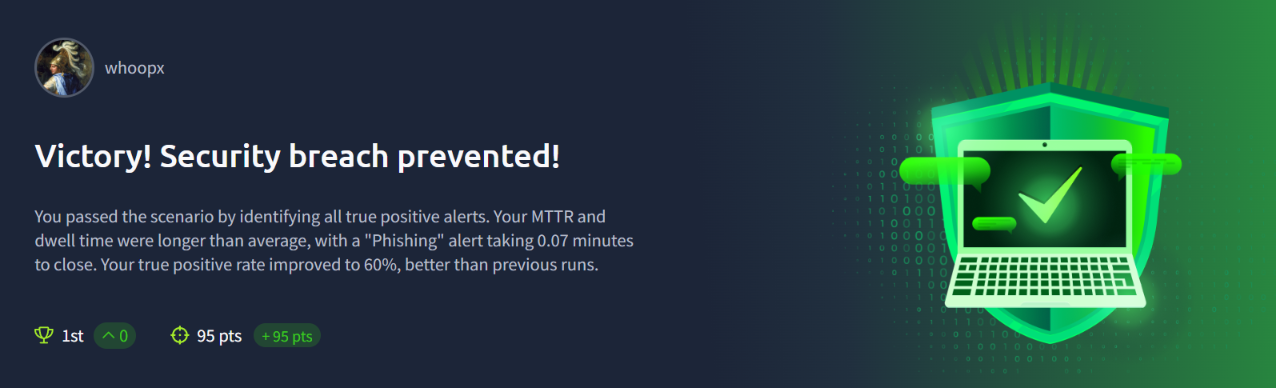
Worked through TryHackMe's SOC Simulator as a Tier 1 analyst, triaging five live alerts in a simulated Splunk environment. Identified three true positive phishing attempts — including a typosquatted Microsoft domain and a lookalike Amazon shipping scam — and correctly cleared two false positives after pivoting through firewall logs and internal correspondence to confirm context.
TryHackMe SOC Simulator - Introduction to Phishing
Alerts Triaged — 5 live alerts worked end-to-end as a Tier 1 SOC analyst inside a simulated Splunk environment
True Positives — 3 confirmed, including a typosquatted Microsoft domain and a lookalike Amazon shipping scam
False Positives Cleared — 2, confirmed by pivoting through firewall logs and internal correspondence for context
Result — 95 points, 1st place on the leaderboard, 60% true positive rate
Read Full Writeup
Incident Response Splunk
CTF
Jul 04, 2026
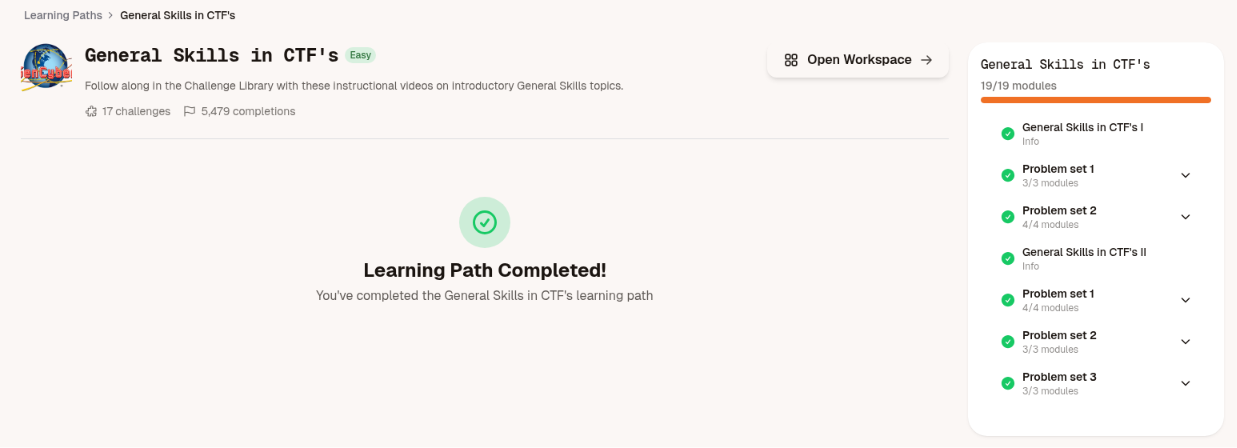
🚩 General Skills — CyLab Security Academy
Completed the General Skills category — the foundational track every CTF player starts with. Most of the modules were finished back when the platform was still known as picoCTF, before its 2026 rebrand to CyLab Security Academy.
General Skills - CyLab Security Academy
Linux Fundamentals — navigating the filesystem, permissions, and piping commands together to hunt down flags
Basic Scripting — quick Python/Bash one-liners to automate repetitive CTF grunt work
Encoding Schemes — Base64, hex, and other common encodings used to hide flags in plain sight
Key Takeaway — General Skills is the on-ramp; every other category (crypto, forensics, web) leans on these fundamentals
View CyLab Profile
CTF
DFIR
Jun 17, 2026
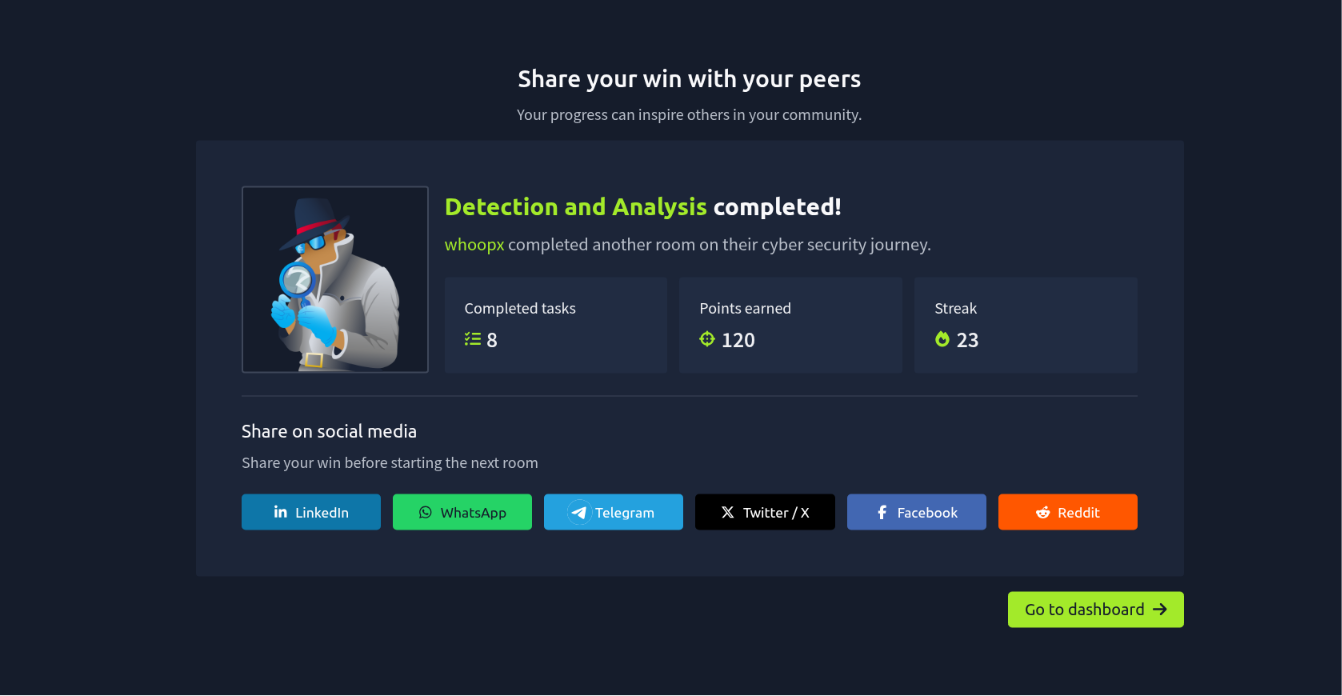
📈 Detection and Analysis — TryHackMe
Picked up where alert triage leaves off — this room dives into the Detection and Analysis phase of incident response. Learned to write SPL queries to dig deeper into logs and build a clearer picture of what actually happened after an alert fires.
Detection and Analysis - TryHackMe
SPL Queries — Writing Splunk Search Processing Language queries to pivot through logs and surface relevant events
Post-Triage Analysis — Moving past the initial alert to confirm scope, timeline, and root cause of an incident
Detection Logic — Understanding how correlation rules turn raw log data into actionable alerts
Key Takeaway — Triage tells you something happened; detection and analysis tells you exactly what, how, and how far it spread
View TryHackMe Room
Incident Response Splunk
SOC
Jun 16, 2026
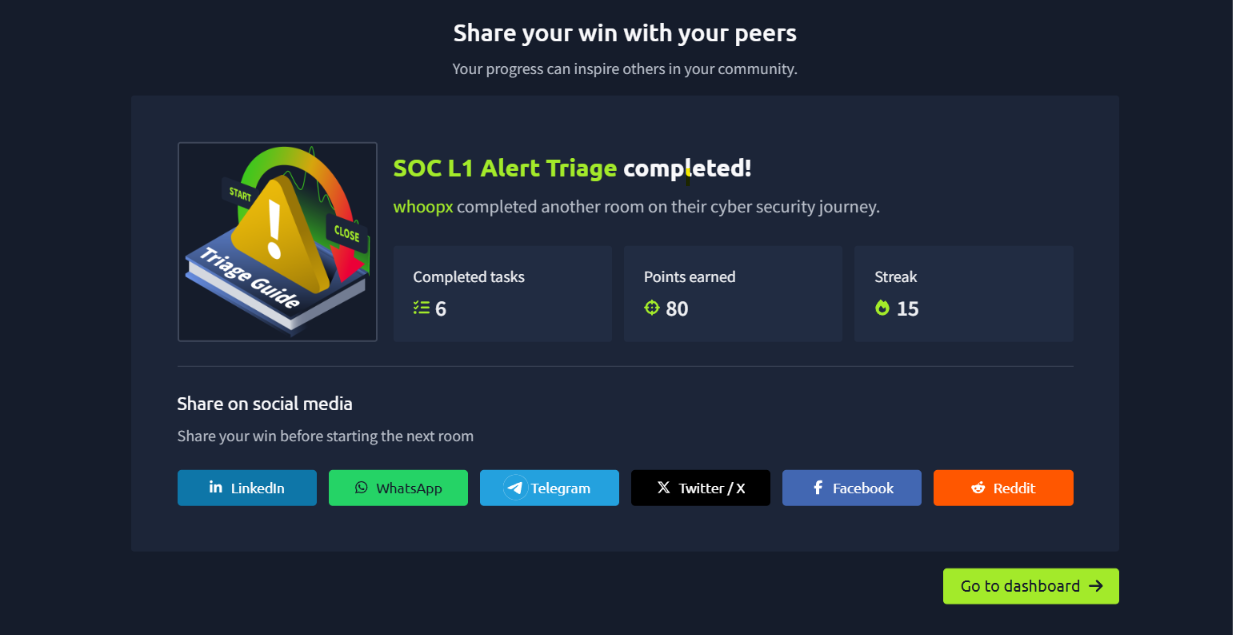
🚨 SOC L1 Alert Triage — TryHackMe
Worked through a hands-on SOC L1 alert triage room with a real dashboard simulation — great way to practice prioritizing alerts, distinguishing false positives from genuine threats, and learning the day-to-day triage workflow analysts use on the job.
SOC L1 Alert Triage - TryHackMe
Real Dashboard Simulation — Practiced triage inside an actual SOC-style alert console, not just theory slides
Alert Prioritization — Sorting alerts by severity and business impact to decide what gets investigated first
False Positive Reduction — Identifying noisy or benign alerts to keep analyst attention on real threats
Key Takeaway — Fast, accurate triage at L1 is what keeps a SOC from drowning in alert fatigue
View TryHackMe Room
Incident Response Splunk
IR
Jun 15, 2026
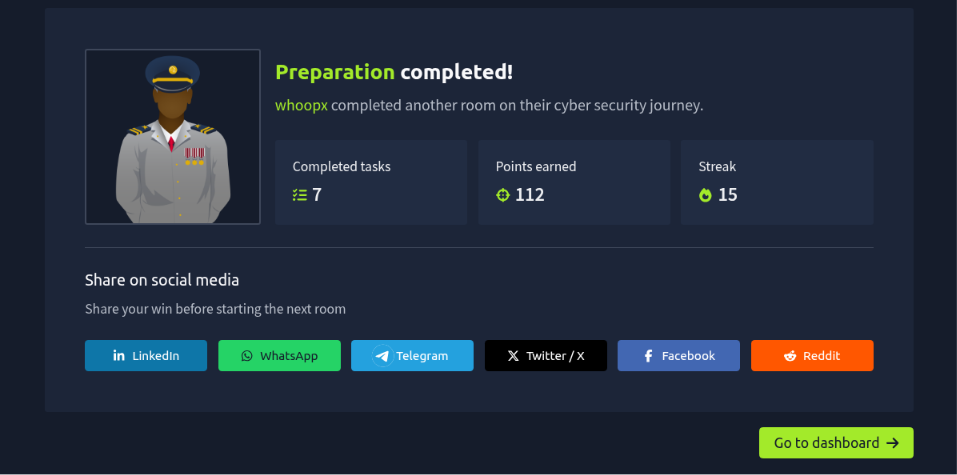
📋 Preparation — TryHackMe
Covered the Preparation phase of incident response — the foundation every SOC team needs before an incident ever happens. Dug into IR frameworks, building a Playbook/Procedure Pyramid (PPP), and the role of visibility, logging, and detection in being truly ready.
Preparation - TryHackMe
IR Frameworks — Structured approaches (NIST, SANS) that define how an organization prepares for and responds to incidents
Playbooks & Procedures (PPP) — Documented response steps that turn chaotic incidents into repeatable, consistent action
Visibility & Logging — Centralized log collection across endpoints and network as the backbone of any detection capability
Detection Engineering — Translating visibility into actionable alerts that catch real threats early
Key Takeaway — You can't respond to what you can't see — preparation is 90% of incident response
View TryHackMe Room
Incident Response
DFIR
Jun 14, 2026
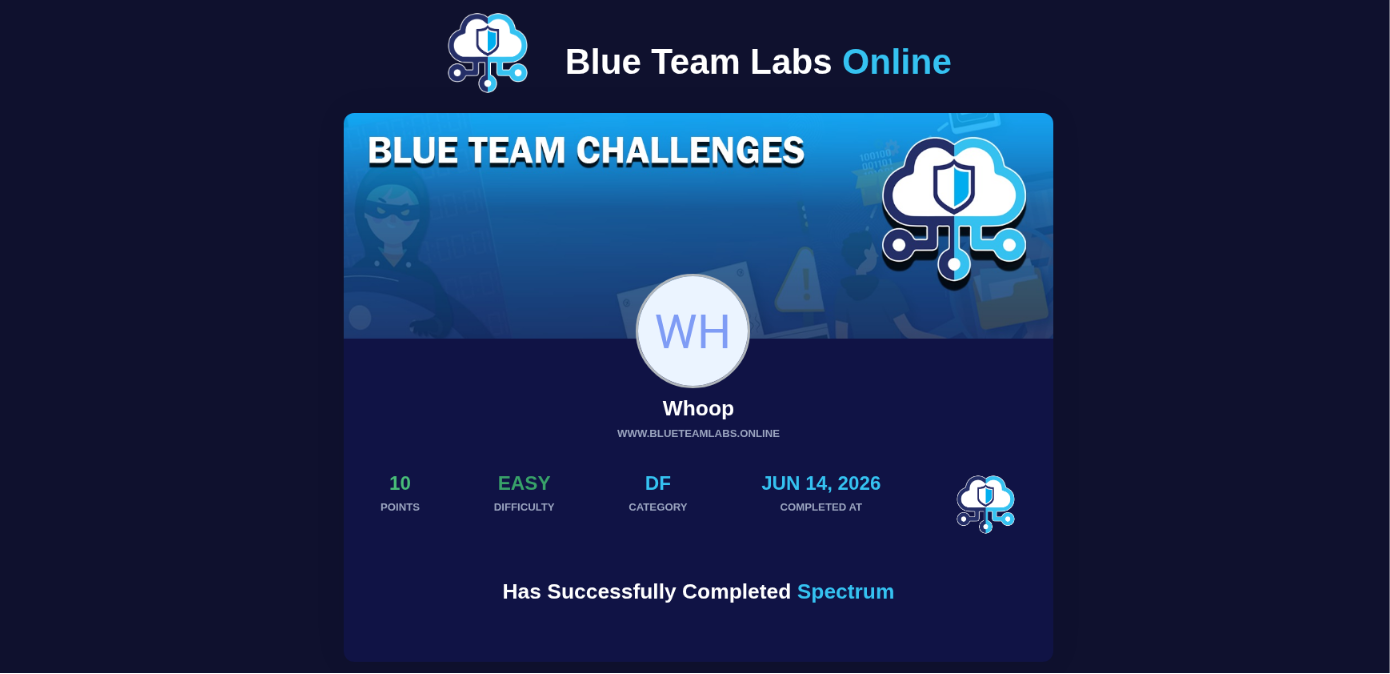
🔍 Spectrum Challenge — Blue Team Labs Online
Tackled the Spectrum challenge on BTLO — a surprisingly realistic forensic investigation combining audio steganography, zip cracking, and hidden data extraction. Audacity, fcrackzip, and steghide made this one a proper toolchain workout.
Spectrum - Blue Team Labs Online
Audacity — Analyzed audio files for hidden data embedded in spectrograms and waveform anomalies
fcrackzip — Brute-forced password-protected zip archives to extract concealed evidence
steghide — Extracted hidden payloads embedded inside image files using steganography techniques
Key Takeaway — Real investigations rarely use one tool — the ability to chain techniques is what separates good analysts
View Challenge
Digital Forensics Incident Response
DFIR
IR
Jun 10, 2026
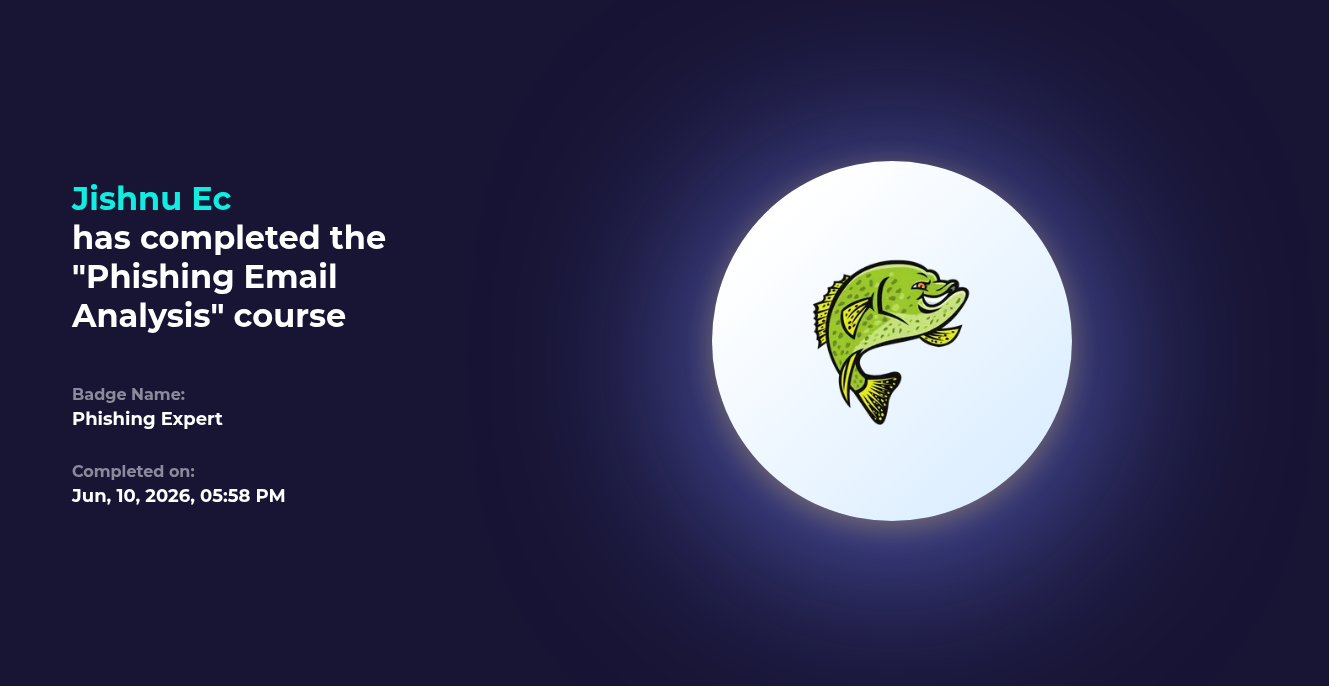
📧 Phishing Email Analysis — LetsDefend
Deep-dived into phishing email analysis — covering static and dynamic techniques to dissect malicious emails, read and trace headers, analyze suspicious attachments, and identify threat actor infrastructure.
Phishing Email Analysis - LetsDefend
Email Header Analysis — Tracing Return-Path, Received headers, and X-Originating-IP to detect spoofing and map the full delivery chain
Static Analysis — Inspecting raw email source, embedded URLs, and attachment hashes without execution
Dynamic Analysis — Safely detonating phishing links and attachments in sandboxed environments for behavioral observation
Key Takeaway — Headers never lie — even the most convincing phish leaves forensic trails in the metadata
View LetsDefend Training
Digital Forensics Incident Response
IR
Jun 09, 2026
📊 Training Impact on Teams — TryHackMe
Explored how structured cybersecurity training drives measurable ROI for security teams — covering skill progression frameworks, detection rate improvements, and how to justify training investment to stakeholders.
Training Impact on Teams - TryHackMe
ROI of Training — Quantifying the return on security training through reduced incident response time and improved detection accuracy
Skill Gap Analysis — Identifying team weaknesses and mapping training paths to close coverage gaps in the security posture
Team Performance Metrics — How training translates directly into faster triage, better threat identification, and lower MTTR
Key Takeaway — A well-trained SOC team is the most cost-effective security control an organization can invest in
View TryHackMe Room
Incident Response
ML / AI
Jun 08, 2026
🤖 AI, ML, DL & LLM Security Threats — TryHackMe
Covered the fundamentals of how AI, ML, DL, and LLMs work — and how they intersect with cybersecurity as both dangerous attack vectors and powerful defensive tools.
AI/ML Security Threats - TryHackMe
AI — The overarching field enabling machines/systems to mimic human behaviour and decision-making
Machine Learning — A subfield of AI where models are trained on input data to learn patterns and make predictions
Deep Learning — A subfield of ML using Neural Networks to self-learn and process mass amounts of data without human interaction
LLMs & Cyber Offense — AI-powered phishing, automated vulnerability discovery, deepfake social engineering
AI in Defense — Anomaly detection, intelligent SIEM correlation, and ML-driven threat hunting
View TryHackMe Room
Machine Learning
DFIR
Jun 06, 2026
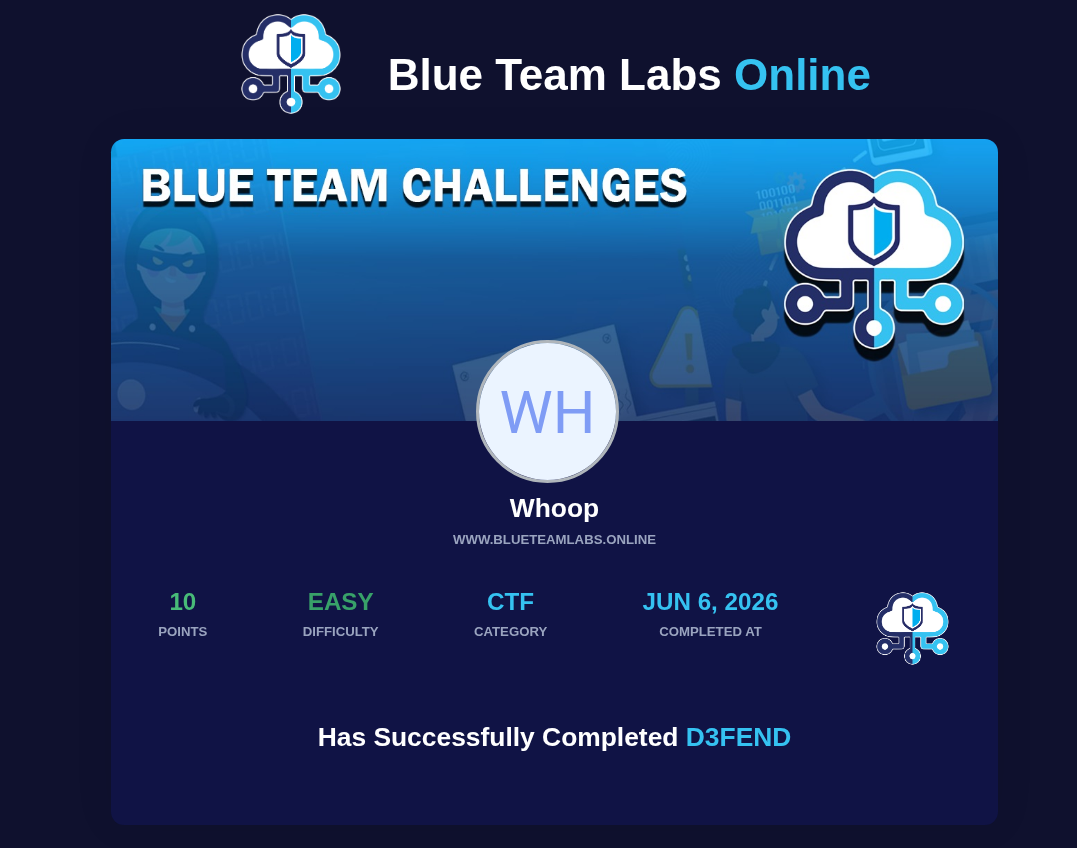
🛡️ D3FEND Challenge — Blue Team Labs Online
Looks like a small one, but it’s deeply rooted to the core of MITRE D3FEND — a knowledge graph of cybersecurity countermeasures that maps defensive techniques against adversarial TTPs.
D3FEND - Blue Team Labs Online
View Challenge
Digital Forensics Incident Response
Pentest
CTF
Jun 04, 2026
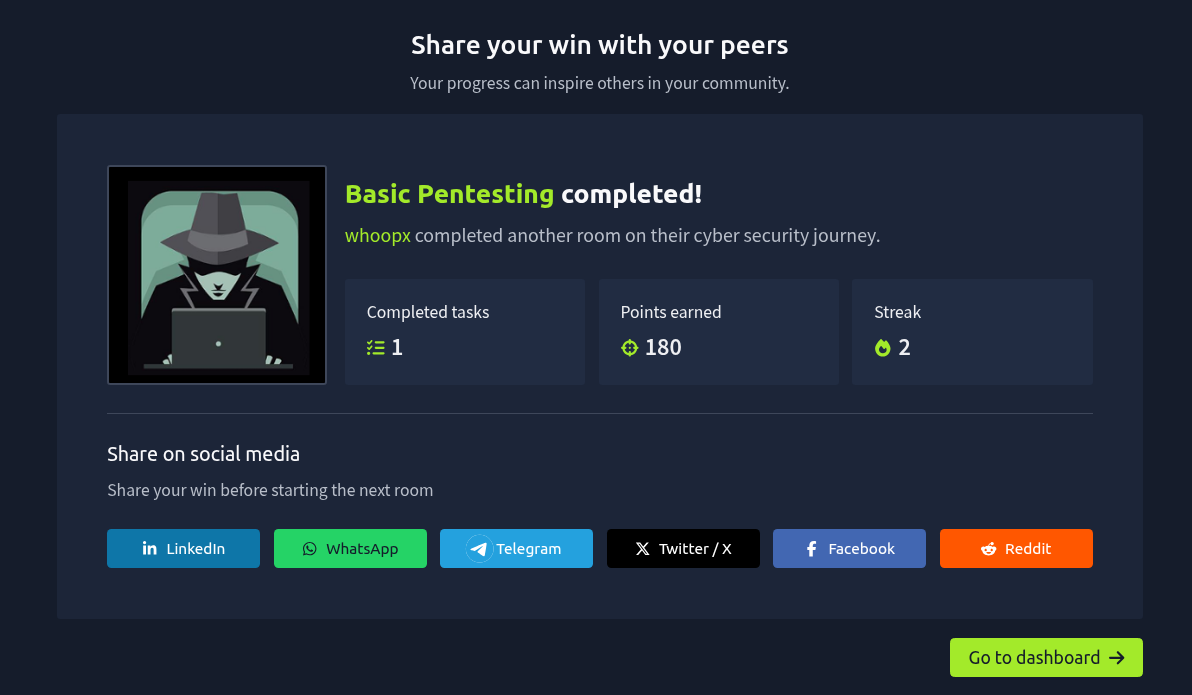
🔓 Basic Pentesting — TryHackMe
Worked through the Basic Pentesting room on TryHackMe — a beginner-to-intermediate Linux box covering the full kill chain: enumeration, exploitation, and privilege escalation to root.
Basic Pentesting - TryHackMe
Enumeration — Nmap service scan, Gobuster directory brute-force, SMB enumeration
Exploitation — Weak SSH credentials discovered via Hydra brute-force — initial foothold gained
Privilege Escalation — Linux privesc to root via misconfigured sudo permissions
Key Takeaway — Thorough enumeration is the foundation of every successful pentest
View TryHackMe Room Read Full Writeup
Penetration Testing CTF
DFIR
Apr 09, 2026
🧠 Learning Volatility — A Path Toward Forensic Archiving
Mastering Volatility isn't just about live incident response — it's a foundational step toward forensic archiving. Memory artifacts captured today can be preserved and referenced in case files long after the incident closes.
Forensic Archiving — Volatility outputs (pslist, netscan, malfind) exported as structured evidence for case records
Memory Artifact Preservation — volatile evidence captured before power-off becomes a permanent forensic record
Plugin Deep Dive — cmdline, dlllist, handles, and filescan reveal attacker footprint even without disk artifacts
Key Insight — Fileless malware leaves no trace on disk, but memory never lies
Digital Forensics
DFIR
IR
Apr 08, 2026
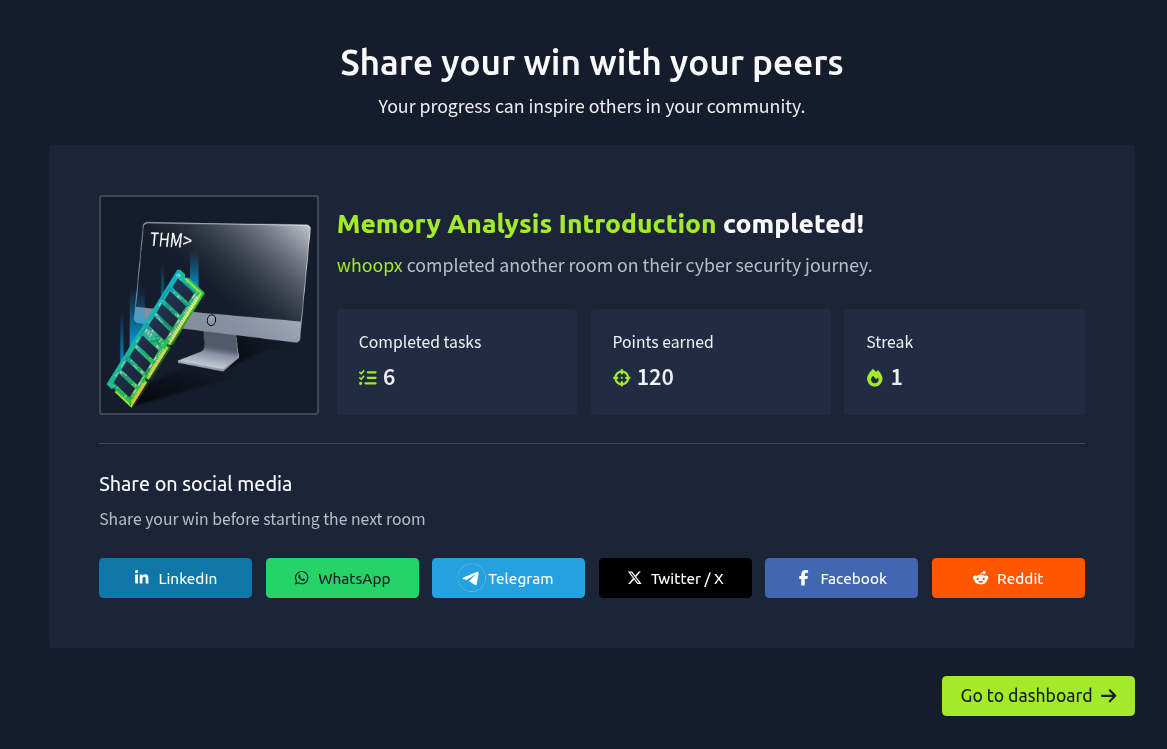
🚀 Completed Memory Analysis Introduction — TryHackMe
Dived into the fundamentals of memory forensics — how RAM works, how attackers exploit it, and how defenders catch threats in-memory before any trace hits disk.
Memory Analysis Introduction - TryHackMe
RAM & Memory Structures — Stack, Heap, User vs Kernel Space
Process & Full Memory Dumps — capturing volatile data before it's gone
Code Injection Detection — identifying injected shellcode inside process memory
First Steps with Volatility — hands-on dump analysis and plugin usage
View TryHackMe Room
Digital Forensics Incident Response
CTF
Pentest
Feb 15, 2026
🚩 Released Udyama — My First Custom CTF Machine
Designed and packaged a fully custom Linux CTF VM with 2 flags — User and Root. Focused on real-world privilege escalation paths, not contrived puzzle challenges. Packaged as Ubuntu OVA for VirtualBox.
Platform — Ubuntu 22.04 OVA, runs in VirtualBox
Difficulty — Intermediate to Advanced
Focus — Realistic Linux privilege escalation & persistence techniques
Hosted on archive.org — free to download for the community
Download OVA
CTF Penetration Testing
IR
Mar 10, 2025
🛡️ Completed DFIR Introduction — TryHackMe
Solid grounding in Digital Forensics & Incident Response fundamentals — the methodology that separates a reactive responder from a structured, methodical analyst.
PICERL Framework — Preparation, Identification, Containment, Eradication, Recovery, Lessons Learned
Evidence Handling — Chain of Custody, Evidence Preservation, Order of Volatility
Tools Covered — EZ Tools, KAPE, Autopsy, Volatility
Key Takeaway — Always collect most volatile evidence first; RAM disappears at shutdown
View THM Room
Digital Forensics Incident Response
DFIR
OSINT
Feb 24, 2025
🔥 MemLoot Challenge — Ransomware Hidden as Spotify Installer
Analyzed a Windows memory dump using Volatility 3. A fake Spotify installer turned out to be Dark Havoc ransomware — a classic trojan delivery technique caught through memory forensics.
Malicious File — Spotify_setup.exe identified as Dark Havoc ransomware
C2 Server — 104.152.52.238:6548  ·  Encryption extension: .havoc
Execution Vector — Parent process explorer.exe, user double-clicked the fake installer
Detection Method — Process tree analysis + network artifacts from memory dump
View Challenge
Digital Forensics Incident Response OSINT
ML / CV
May 10, 2025
🛡️ Built Driver Vigilance — Real-Time Distraction Detection with ML
Designed and built a machine learning–driven driver monitoring system capable of detecting dangerous driving behaviors in real time — phone usage, turning around, reaching to the rear — and issuing instant alerts before they cause accidents.
Detection Scope — Phone usage, rear-seat distraction, abnormal head & body orientation
Core Stack — Python + OpenCV + ML classification model on live video input
Alert System — Real-time warnings triggered at configurable confidence thresholds
Key Insight — Most accidents begin 0.5–2 seconds before impact; real-time is the only acceptable latency
Read Full Writeup
Machine Learning
// No posts found
Showing 2 of 19
08Cyberspace Profiles
09Contact
Let's secure the
digital world together.
Open to SOC Analyst · Cybersecurity Analyst · Penetration Tester roles